
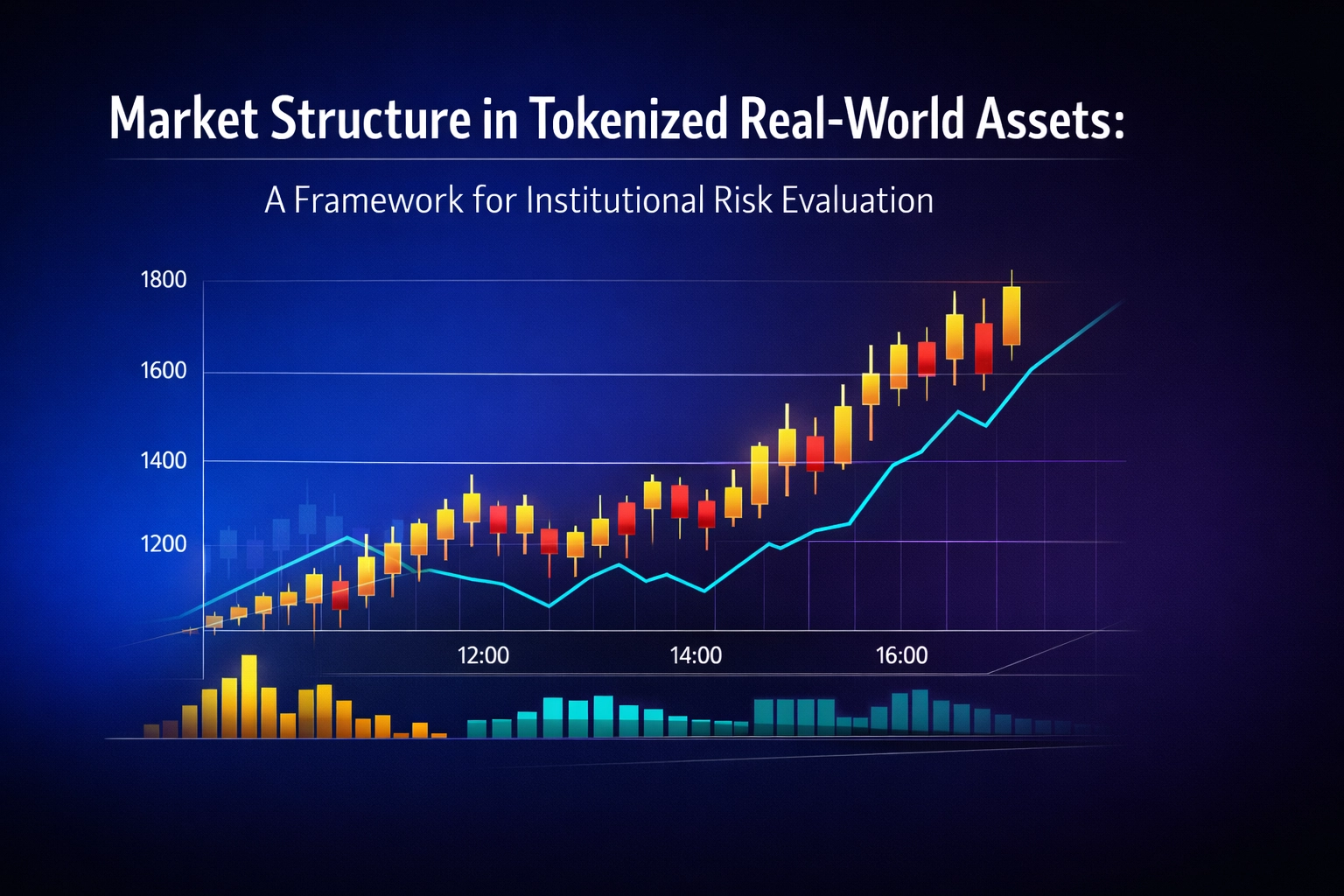
Tokenized real-world assets represent approximately $33 billion in on-chain value as of Q4 2025, yet institutional asset tokenization remains incompletely understood through the lens of traditional risk frameworks. The core challenge facing investment committees is not whether tokenization offers operational efficiency: it does: but rather how to evaluate the structural divergence between on-chain representations and their underlying off-chain assets.
This divergence introduces basis risk, tracking error, and liquidity fragmentation that differ fundamentally from traditional securitization models.

Market Composition and Scale
The RWA market structure is concentrated in government securities, particularly U.S. Treasuries, which anchor the asset class alongside stablecoins. This composition reflects both regulatory clarity in sovereign debt markets and the relative simplicity of tokenizing liquid, standardized instruments.
Beyond this foundation, diversification is accelerating across real estate (projected to reach $1.4 trillion by 2026), commodities (exceeding $2 billion, predominantly gold-backed tokens), and emerging allocations in private equity and credit. The expansion into less liquid asset classes introduces complexity that institutional risk teams must evaluate independently from the tokenization infrastructure itself.
Growth projections range from $2 trillion to $4 trillion by 2030, driven primarily by institutional adoption rather than retail speculation. This trajectory suggests market maturation, yet the structural characteristics remain nascent relative to decades-old securitization markets.
Trading Infrastructure and Fragmentation
Tokenized assets trade across more than 200 centralized exchanges and 500+ decentralized exchanges, creating a fragmented liquidity environment unlike traditional bond or equity markets. This fragmentation has direct implications for execution quality, price discovery, and the measurement of tokenized assets tracking error.
Unlike centralized limit order books with consolidated tape infrastructure, tokenized RWA liquidity is distributed across disparate venues with varying custody models, settlement finality mechanisms, and counterparty frameworks. This structural reality introduces operational complexity and requires sophisticated execution strategies to manage slippage and venue-specific risk.

For investment committees evaluating tokenized treasuries or credit instruments, understanding venue-level liquidity depth and cross-venue arbitrage dynamics is foundational to assessing whether on-chain pricing accurately reflects underlying asset valuations.
Basis Risk and Price Dislocation
The primary risk consideration in asset tokenization analytics is the potential for persistent divergence between token prices and the net asset value of underlying collateral. This basis risk in tokenized assets manifests differently than in traditional derivatives or ETF structures due to:
Settlement asynchronicity: On-chain tokens trade 24/7 with near-instant settlement, while underlying assets may have T+1 or T+2 settlement cycles and limited trading hours. This temporal mismatch creates arbitrage windows and potential price dislocation during periods of market stress.
Redemption mechanisms: Unlike open-end funds with daily NAV-based redemptions, tokenized assets often lack standardized, capital-efficient redemption processes. The absence of authorized participant arbitrage mechanisms can allow premiums or discounts to persist beyond what would be tolerable in traditional structures.
Oracle dependencies: Valuations of tokenized private credit, real estate, or other less liquid assets rely on off-chain data feeds and appraisal methodologies. Oracle failures or manipulation introduce a technology-layer risk absent in traditional custody and valuation frameworks.
Structural Considerations for Risk Evaluation
Investment committees should evaluate tokenized real-world assets through a dual lens: the efficiency gains from programmable settlement and fractional ownership, balanced against operational and technology risks specific to emerging infrastructure.
Critical evaluation criteria include:
Liquidity depth: Bid-ask spreads, order book depth, and historical trading volumes across fragmented venues provide insight into execution risk and potential slippage during portfolio rebalancing.
Custody and settlement: Whether token holders have direct legal claim on underlying assets, or whether tokenization represents a claim on an intermediary, determines solvency risk and bankruptcy remoteness.
Smart contract risk: Code-layer vulnerabilities, upgrade authority, and historical audit records should be evaluated with the same rigor applied to third-party fund administrators.
Regulatory clarity: Jurisdictional differences in securities classification, tax treatment, and investor protection frameworks introduce legal basis risk that varies by issuer domicile.
Implications for Institutional Adoption
The transition from fragmented, early-stage tokenization to integrated institutional infrastructure is underway but incomplete. For risk teams, this presents a framework challenge: traditional risk metrics such as duration, credit spread, and volatility remain relevant, but must be supplemented with on-chain-specific considerations including smart contract risk, oracle reliability, and cross-chain settlement finality.
Tokenized assets are not simply digital wrappers around traditional securities. They represent a distinct market structure with unique risk characteristics that require independent evaluation, monitoring, and control frameworks.
Institutional clarity on asset tokenization risk begins with recognizing this structural divergence: not as a barrier to adoption, but as a distinct risk profile requiring appropriate analytical tools and governance processes.
Leave a Reply